
The Missing Eight Minutes
A Curious Files Investigation File 002
ILLUSTRATED STORIESCURIOUS SCIENCE
By Richard Marc & Devon (AI Archive Assistant)
3/13/20265 min read

For as long as anyone can remember, people have occasionally experienced a strange sensation.
You walk into a room and feel certain you’ve already been there.
Someone begins a sentence and you somehow know exactly how it will end.
A moment unfolds with eerie familiarity.
Science has a name for it.
Déjà vu.
For decades, scientists have reassured the public that the explanation is simple.
Harmless.
Even boring.
A minor delay in the brain’s memory system causes a moment to be mistakenly filed as something already experienced. A small neurological hiccup. Case closed.
At least… that’s the official explanation.
The First Experiments
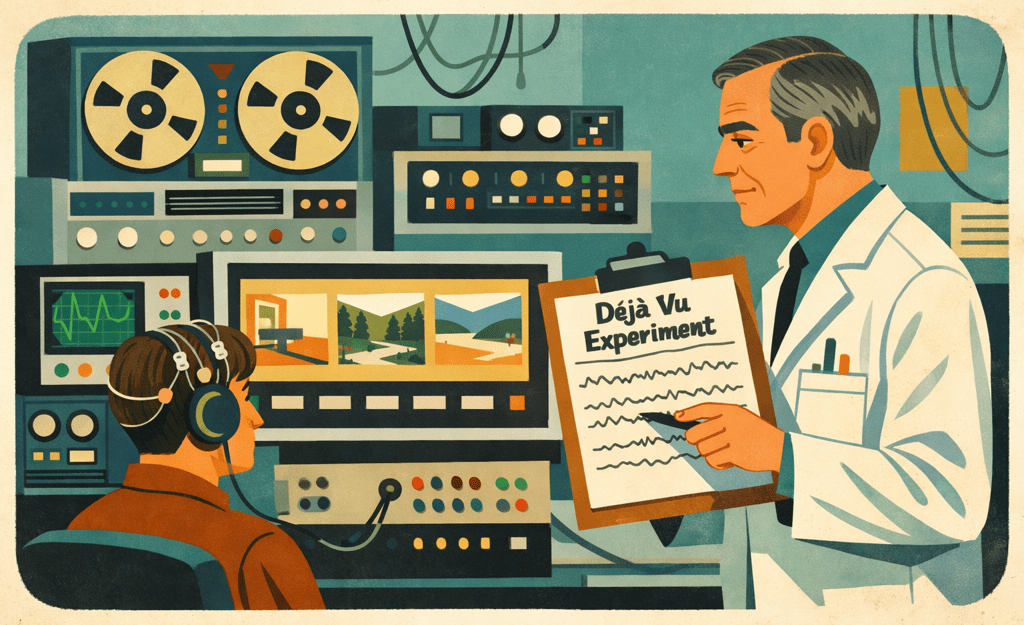
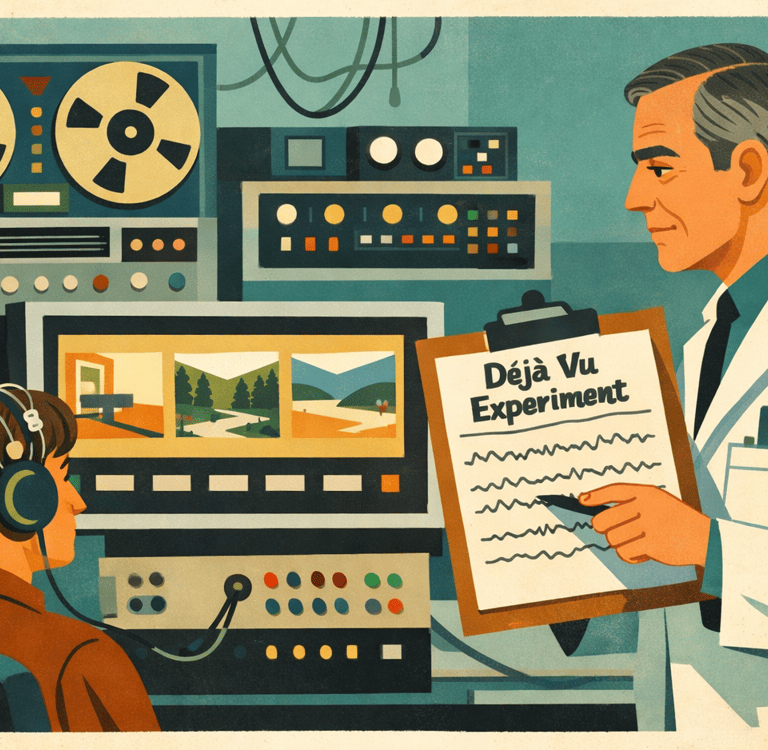
In the early 1970s, neuroscientists began running controlled experiments to understand déjà vu. One of the leading researchers was Dr. Leonard Weissmann, a cognitive neurologist at the University of Chicago. Weissmann designed a simple but clever test.
Subjects were shown a rapid sequence of images; rooms, landscapes, city streets—while their brain activity was carefully monitored. Occasionally, an image was repeated in the sequence. Participants consistently reported a powerful sense of familiarity when the image appeared again.
Weissmann concluded that déjà vu was caused by brief misfires in the brain’s memory circuitry. His findings were widely published. The explanation became accepted scientific doctrine.
Textbooks repeated it.
Medical journals cited it.
And the public accepted it without question.
The Quiet Conference
In 1983, a small group of researchers gathered at a closed symposium in Geneva. The meeting was officially titled:
The International Conference on Cognitive Temporal Processing.
The agenda sounded harmless enough:
• memory formation
• perception of time
• neurological anomalies
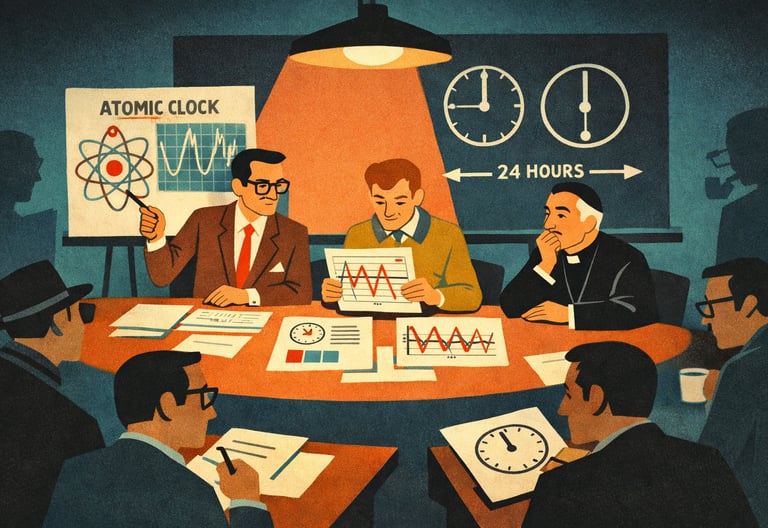
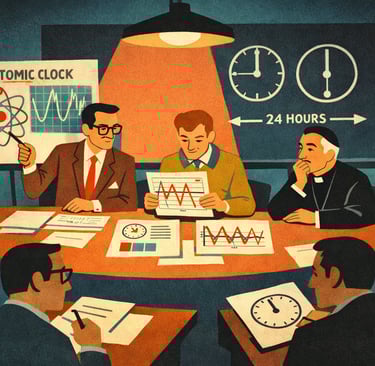
But the conference had an unusual list of attendees. Not only neuroscientists. Also, in attendance were:
Dr. Anika Feldmann, chronobiologist from the Max Planck Institute
Professor David Hargrove, experimental physicist specializing in atomic clock synchronization
Father Matteo Rinaldi, theologian and scholar of philosophical time perception
Theologians rarely attend neuroscience conferences. But Father Rinaldi had been invited for a specific reason.
Some of the researchers were beginning to suspect that the phenomenon being studied wasn’t entirely neurological.
The Data Problem
During the conference, Professor Hargrove presented something troubling. Atomic clock data collected from multiple laboratories showed irregularity. Not large enough to alarm anyone. But it is impossible to explain.
Once every twenty-four hours, the clocks displayed a tiny discontinuity. A correction. Exactly eight minutes and a few seconds.
The anomaly was dismissed as calibration noise. But Hargrove disagreed. “Noise,” he told the room quietly, “does not occur with perfect daily regularity.”
Papa’s Observation
Years later, Papa encountered the idea completely by accident. He had been reading a forgotten conference summary in an old journal when something caught his attention.
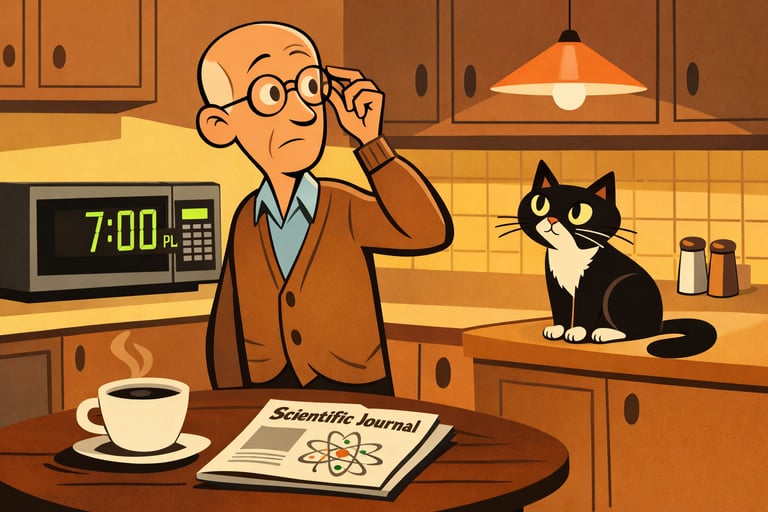
The clock in his kitchen microwave read 6:52 PM.
Papa poured himself a cup of coffee and sat down at the table with the paper. When he looked back up again, the clock read 7:00 PM.
Papa frowned. He was quite certain that only a moment had passed. Papa adjusted his glasses.
Then he wrote a note in the margin of the article.
“Where did the eight minutes go?”
As Papa continued reading, something else in the journal began to trouble him. A widely circulated paper explaining humanity’s increased life expectancy had attributed the change to slightly shortened digital seconds. The mathematics appeared convincing at first glance, but Papa quickly noticed that the published calculations contained a small but noticeable error.
Papa tapped his pencil against the page and added another note beside the figures.
“If the numbers were correct, the adjustment would account for only a few hours per year — not the dramatic statistical gains being reported.”
He leaned back in his chair and studied the page.
“Perhaps the improved life expectancy statistics were never caused by shorter seconds at all.”
Papa closed the journal slowly.
“Perhaps,” he murmured
“We were looking at the wrong clock.”
The Accepted Explanation
Modern neuroscience continues to describe déjà vu as a memory processing glitch.
When the brain briefly misroutes sensory information, an experience is mistakenly interpreted as a memory. A simple timing error between two regions of the brain.
Elegant.
Comforting.
Harmless.
The explanation appears in textbooks, psychology courses, and documentaries.
But Papa noticed something curious.Nearly every explanation includes a phrase like: “a brief delay in neural processing.”Papa circled the word delay.Then he circled brief.
Father Rinaldi’s Question
During the Geneva conference decades earlier, Father Matteo Rinaldi had raised a question that unsettled the room. “If memory can be misfiled,” he said, “we assume the error occurs in the mind.”
He paused. “But what if the mind is remembering something that truly occurred?”
The room fell silent. Rinaldi leaned forward. “What if the experience of déjà vu is not a mistake…”
“What if it is a memory of time that has been removed?”
The Uncomfortable Possibility
Papa sat quietly in his kitchen considering the idea. Suppose the brain’s explanation was correct. Suppose there really was a delay between perception and memory. But what if the delay wasn’t happening in the brain at all?
What if the delay existed in time itself?
Eight minutes.
Every day.
Gone.
Erased from human experience.
Occasionally, the mind might still remember fragments of those missing moments. The memory would feel strange.
Out of place. Like something that had already happened. Déjà vu.
The Real Question
Papa closed the journal and looked again at the microwave clock.
7:03 PM. The kitchen was quiet. Darla the tuxedo cat sat on the counter watching him carefully. Papa tapped his pencil against the table.
“Scientists say déjà vu is just a glitch in memory,” he said thoughtfully.
He paused. “But if eight minutes of every day quietly disappear…”
Papa looked back at the clock. “…then the real mystery isn’t why we sometimes remember them.”
He leaned back in his chair.
“The real question,” Papa said softly, “is this.”
“Where do the missing eight minutes go?”
Papa’s Reality Check
Papa adjusts his glasses and clears his throat.
“This story is speculative fiction. No confirmed evidence exists that eight minutes of every day mysteriously vanish from human experience.”
He glances once more at the clock.
“…although if the next few minutes feel strangely familiar, you might want to keep an eye on the time.”



Essentials
© 2025. All rights reserved.

“Follow the latest incidents”
“New designs added regularly”
Email signup (optional)